


Key Takeaways
- A column’s data type affects table size, index size, how values are compared, and how efficiently queries run.
- Choose types by what the data means and its expected range, not by convenience or the smallest size.
- Use native types (
numeric,date,timestamptz,boolean,uuid,jsonb) instead of storing everything astext. - Larger types make larger indexes, which means more disk, I/O and cache pressure, and that only becomes visible at scale.
- Matching application parameter types to column types avoids unnecessary conversions that can stop PostgreSQL using an index.
When designing a PostgreSQL database, choosing a data type can look like a small decision. In reality, the selected data type can affect how much storage the database uses, how indexes are built, how values are compared, and how efficiently queries are executed. These differences may not be obvious when a table has only a few thousand rows, but they can become important when the database grows to millions or billions of rows.
Why Data Types Matter
Every column in PostgreSQL has a data type, and that type tells PostgreSQL what kind of value the column contains and how that value should be handled. For example, a customer’s age, account balance, name, date of registration, and active status are all different types of information, so they should not necessarily be stored in the same way.
A common mistake is choosing a data type simply because it is convenient. For example, using text for almost everything or using bigint for every numeric column may work, but it does not always make sense for the actual data. The better approach is to understand what the column represents, how large the values can become, and how the column will be used in queries.
Integer Types and Storage
PostgreSQL provides different integer types such as smallint, integer, and bigint. The main difference between them is the range of values they can store and the amount of storage they require. An integer is suitable for many normal numeric values, while bigint is useful when a much larger range is required.
For example, if a table stores a quantity that will always remain within a small range, there may be no reason to use bigint. On the other hand, using a smaller type for an ID that may eventually exceed its range can create problems later.
This becomes more important with very large tables. A small difference in the size of one column may not matter for a few thousand rows, but when the same difference exists across hundreds of millions of rows, the total storage impact can become significant. The same consideration also applies to indexes, because indexed values are stored as part of the index structure.
Numeric Types and Exact Values
PostgreSQL provides the numeric type for exact decimal values. It is commonly used when precision is important, especially for financial values. For example, a price can be defined as numeric(12,2) when the application needs exact values with two decimal places.
The benefit of numeric is accuracy, but exact calculations can require more processing than simpler numeric types. This does not mean numeric should be avoided. It means the type should be selected according to the requirements of the data.
For financial calculations, using an exact numeric type is generally more important than trying to save a small amount of storage. For scientific or measurement-related data where a small approximation is acceptable, floating-point types such as real or double precision may be more appropriate.
Text and Varchar
Text columns are another area where developers often make uninformed choices. PostgreSQL supports both text and varchar, and varchar can also be given a maximum length.
For example:
name textand:
name varchar(255)Both can be used to store text, but varchar(255) does not automatically make the column faster or smaller than text. The main reason to use a length limit is when the application has an actual business rule that requires one.
The more important question is whether the value should be stored as text in the first place. For example, storing a date as text may appear convenient, but PostgreSQL then cannot treat it as a real date value. This can make filtering, sorting, validation, and date calculations more complicated.
Date and Time Types
PostgreSQL provides different types for working with dates and timestamps, including date, timestamp, and timestamptz. The correct choice depends on what information the application actually needs.
If the application only needs a calendar date, such as a customer’s date of birth, date is enough. If the exact time is important, a timestamp type should be used. For applications that need to handle time zones, timestamptz can be useful because PostgreSQL can handle the timestamp with time zone information correctly.
Using a full timestamp when only a date is required means storing information that the application does not need. More importantly, storing dates as text removes the benefits of PostgreSQL’s native date and time operations.
Boolean Values
For values that are simply true or false, PostgreSQL provides the boolean type. A column such as is_active is a good example.
is_active booleanSome applications store these values as 0 and 1, or even as text such as ‘yes’ and ‘no’. While these approaches can work, the boolean type makes the purpose of the column clear and allows PostgreSQL to treat the value as a logical condition.
This is a good example of why choosing a data type is not only about storage. A proper type also makes the schema easier to understand and helps maintain consistent data.
UUID and Identifier Storage
UUIDs are commonly used when an application needs globally unique identifiers. PostgreSQL provides a native uuid type, so there is usually no need to store UUID values as plain text.
For example:
id uuidUsing the native uuid type gives PostgreSQL a proper representation of the value. However, UUIDs are larger than typical integer identifiers. When a large table has UUIDs in primary keys, foreign keys, and indexes, the additional size can increase the storage requirements of those indexes.
This does not mean UUIDs should be avoided. They are useful in many systems, especially distributed applications. The important point is to understand their storage characteristics when designing a large database.
JSON and JSONB
PostgreSQL supports both json and jsonb for storing JSON data. The two types are not identical. json stores the original JSON representation, while jsonb stores the data in a binary format that PostgreSQL can process more efficiently for many operations.
For applications that frequently search inside JSON documents, jsonb is often more useful because it supports indexing and efficient JSON operations.
metadata jsonbHowever, JSONB should not automatically replace normal columns. If an application frequently filters, joins, or sorts using a particular value, storing that value in a properly typed column can make the database design easier to understand and query.
JSONB is useful when the data is naturally semi-structured or its structure needs to remain flexible. It should not simply be used as a way to avoid designing the schema.
How Data Types Affect Indexes
Data types also affect indexes. When a column is indexed, the indexed values become part of the index structure. Larger values can therefore result in larger indexes.
For example, an index on an integer ID will generally have a different storage footprint from an index on a large text value. A larger index can require more disk space and may also require more I/O when PostgreSQL needs to read it.
This is why data type selection should not be considered only from the perspective of table storage. If a column is frequently indexed, the size and characteristics of that data type can also affect the overall database footprint.
Data Type Conversion and Query Performance
Another issue can occur when the data type used by the application does not match the type of the database column. PostgreSQL may need to perform type conversion when comparing the values.
For example, if a column is stored as an integer but an application frequently sends a value using a different type, PostgreSQL may need to resolve that difference while planning or executing the query. Depending on the expression and available operators, this can affect how efficiently PostgreSQL can use an index.
For this reason, it is generally better for application parameters and database columns to use compatible data types. A query that looks simple on the surface can behave differently when unnecessary conversions are involved.
Storage Becomes More Important at Scale
Data type choices become much more noticeable as the database grows. Saving a few bytes on a table with 10,000 rows may not make much difference. The same saving across 500 million rows can become a significant amount of storage.
The impact is not limited to the table itself. Larger rows can affect how many rows fit into PostgreSQL pages, while larger indexed values can increase index size. This can influence I/O, caching, backups, replication, and the amount of data PostgreSQL needs to process during queries.
This is why a data type that seems perfectly fine during development can become a concern when the same database reaches production scale.
Choosing the Right Data Type
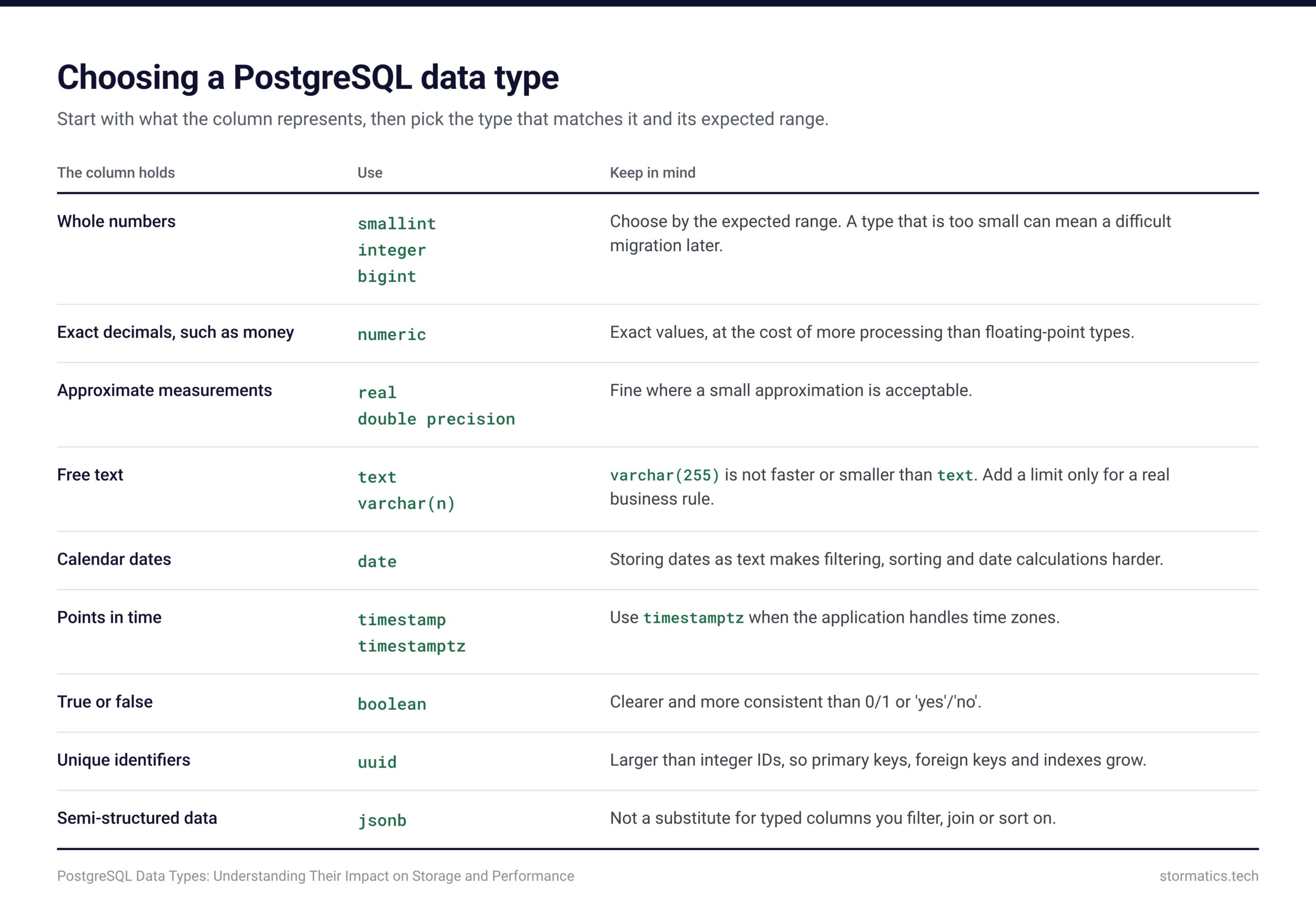
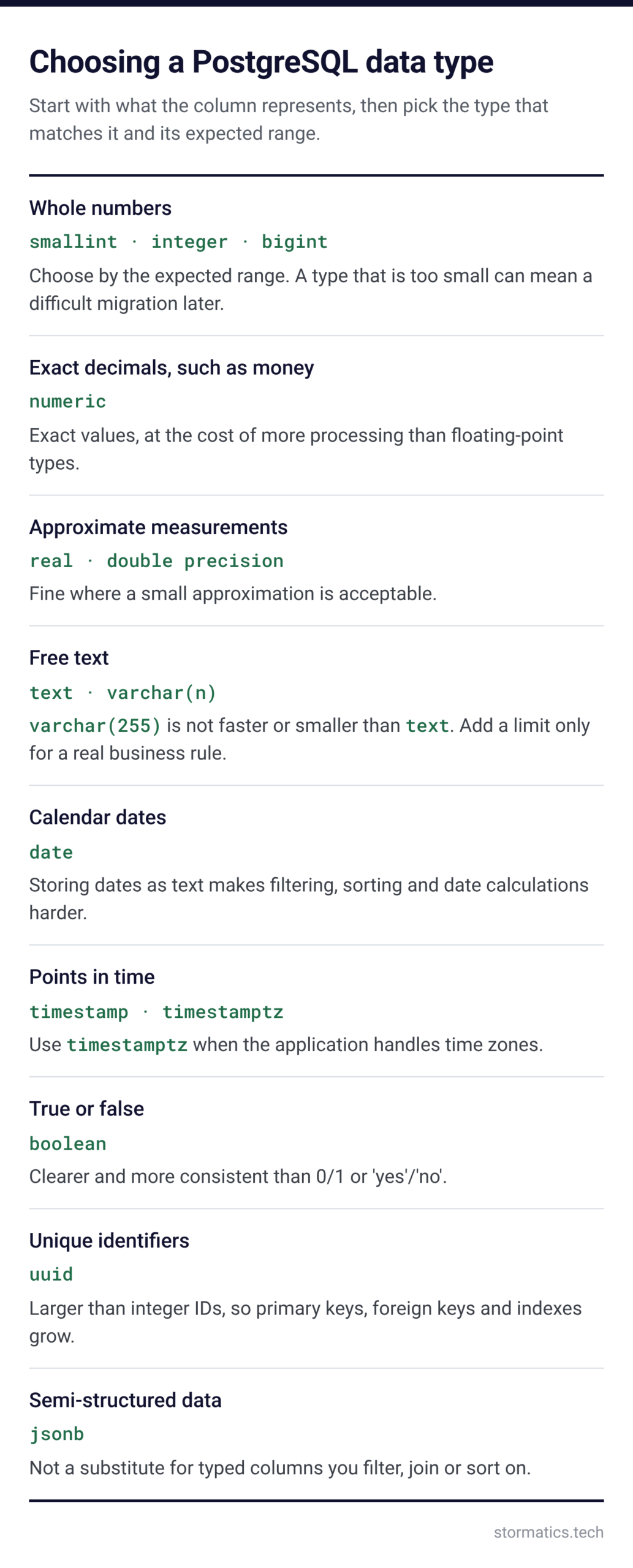
The best approach is to start with the meaning of the data rather than trying to choose the smallest possible type. First understand what the column represents, then select a PostgreSQL type that correctly matches that value and its expected range.
For example, use integer types for whole numbers, numeric when exact decimal precision is required, boolean for true or false values, date for dates, timestamp types for time-related values, uuid for unique identifiers, and jsonb when the data is genuinely semi-structured.
The way the column will be queried should also be considered. A column that is frequently used in filters, joins, or indexes deserves more attention because its data type can have a wider effect on query performance and storage.
Future growth is another important factor. Choosing a type that is too small may require a difficult migration later, while choosing unnecessarily large types everywhere can increase storage and index size without providing a real benefit.
A Practical Production Scenario
Consider an application that stores transaction data. During development, the table contains only a few thousand records, so almost any reasonable data type appears to work well. After several years, the same table grows to hundreds of millions of rows and several columns become heavily indexed.
At this point, data type decisions that looked insignificant during development can have a much larger impact. Larger columns mean more storage, larger indexes, more I/O, and potentially more data that PostgreSQL needs to read during queries.
Changing these types later may also require a large migration, depending on the table size and the type of change. This is why data type decisions are worth considering early instead of waiting until the database has already grown significantly.
Already in production? A PostgreSQL Architecture and Performance Health Check shows where database size, index usage and I/O are heading, so you can act on schema choices before they turn into a large migration.
What Should We Avoid?
One common mistake is using text for every value simply because it is flexible. This can make the schema less clear and removes some of the benefits of PostgreSQL’s native data types.
Another mistake is choosing a type only because it uses less storage. A smaller type is not automatically better if the application may eventually exceed its range or if the type does not correctly represent the data.
It is also not a good idea to put every field into JSONB just to avoid defining proper columns. JSONB is powerful, but frequently queried relational data is often easier to manage when it is stored in properly typed columns.
Finally, data types should not be changed only for theoretical performance improvements. The actual table size, workload, indexes, and query patterns should be considered before making a change.
The Main Idea
PostgreSQL data types are more than labels that define what a column can contain. They influence how PostgreSQL stores, compares, processes, and indexes the data.
A good data type should correctly represent the value, provide enough range for expected growth, and fit the way the application uses that column. The smallest possible type is not always the best choice, and the most flexible type is not always the most efficient one.
For small tables, these differences may be difficult to notice. For large production systems, however, they can affect storage requirements, index size, I/O, caching, and query performance.
Final Thoughts
Choosing the right PostgreSQL data type is an important part of database design. The decision affects more than the column definition. It can influence table size, index size, query processing, storage usage, and long-term maintenance.
The best approach is to understand the data first and then select a type that represents it correctly, supports the expected range, and fits the workload. Data types such as integers, numeric values, text, dates, timestamps, UUIDs, booleans, and JSONB all have different purposes and trade-offs.
The main lesson is simple: a data type may look like a small schema decision, but its impact can become significant as the database grows. Choosing appropriate types from the beginning can help keep PostgreSQL databases more efficient, predictable, and easier to maintain in production.
If large tables, growing indexes or slow queries are already costing you, our PostgreSQL performance optimization and scaling team can find where your schema and indexes are holding you back, and help you fix it.
FAQ
Does varchar(255) make a PostgreSQL column faster or smaller than text?
No. Both store text, and varchar(255) does not automatically make the column faster or smaller than text. Use a length limit only when the application has an actual business rule that requires one.
Should I use numeric or double precision for money in PostgreSQL?
Use numeric for financial values, where exact decimal values matter more than saving a small amount of storage. Floating-point types such as real or double precision suit scientific or measurement data where a small approximation is acceptable.
Do UUID primary keys affect PostgreSQL storage?
Yes. UUIDs are larger than typical integer identifiers, so when they are used in primary keys, foreign keys and indexes on a large table, they increase the storage requirements of those indexes. They are still useful, especially in distributed applications.
When should I use jsonb instead of regular columns?
Use jsonb when the data is naturally semi-structured or its structure needs to stay flexible. Values that are frequently filtered, joined or sorted are easier to manage and query in properly typed columns.
Can a data type mismatch slow down PostgreSQL queries?
It can. When the application sends a value with a different type from the column, PostgreSQL may need to convert it, which can affect how efficiently it uses an index. Keep application parameters and column types compatible.