


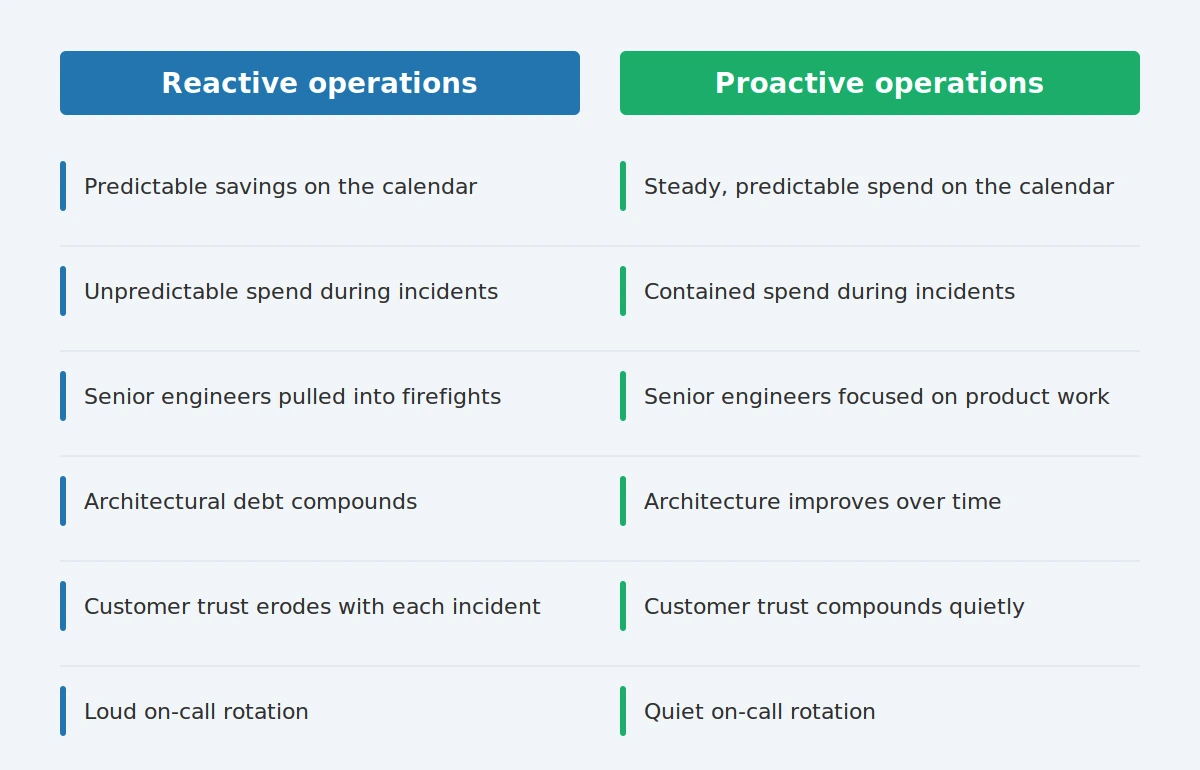
The heroism trap
Here is the part that tends to start arguments, so let me be direct about it.
Engineering culture celebrates the engineer who rescues production at 3am. The Slack channel fills with applause. The story gets told at the all-hands. The recovery becomes part of the legend.
Aviation does the opposite. The pilot who lands a plane after a fuel leak gets a medal, sure. The maintenance crew that would have caught the leak before takeoff gets the budget. The whole industry is organized to keep heroism rare because every act of heroism is also evidence that the system allowed something to go wrong.
Database operations would benefit from the same shift. A pager that rings often is a signal worth listening to. A team that has the recovery playbook memorized is a team whose database has been allowed to be exciting for too long. The goal is fewer heroes and more boring Tuesdays.
What “exciting” actually looks like
Before getting to the cadence, it helps to name the pattern. An exciting database has a few tells, and most teams running one will recognize at least three of them on sight.
The on-call rotation has a rhythm to it, and the rhythm is loud. Pages land in clusters, often during the same windows. The team has unofficial nicknames for the recurring offenders, the query that always shows up at month-end, the job that backs everything up on Sunday nights, the dashboard that stops updating once a quarter. Everyone knows the workarounds. Nobody has had time to fix the underlying causes.
Performance moves around without warning. A query that ran in 200 milliseconds last week takes four seconds today, and nobody has a clean answer for why. The team reaches for the same handful of explanations (statistics, autovacuum, a noisy neighbor) and tries them in order until one works. The fix gets applied. The root cause stays unconfirmed. The same symptom returns in six weeks, and the cycle starts over.
Senior engineers spend a meaningful slice of their week in incident channels. The product roadmap slips quietly, one Friday afternoon at a time. A planned feature gets pushed because the team that was supposed to build it spent three days last sprint chasing a replication lag that turned out to be a long-running analytics query nobody had documented.
Backups exist, but the last full restore drill happened a long time ago. The team is fairly sure the backups would work in a real disaster. Fairly sure is a hard thing to say out loud, so it tends to stay unsaid.
Architectural decisions get deferred because there is no bandwidth for them. The schema change that would simplify three downstream systems waits another quarter. The partitioning strategy that would calm down vacuum waits another quarter. Each deferral is reasonable on its own. Together, they form a slow drift toward more excitement.
If two or three of those patterns sound familiar, the database has been allowed to be exciting for a while. That recognition is the moment the cost math from earlier in this post stops being abstract. The bill is already being paid. The question is what to do about it.
What boring on purpose looks like, week to week
A practical rhythm helps. The cadence becomes the product.
Daily, the team reviews signals against baselines and triages alert noise so that real signals stay loud. Weekly, slow query trends, bloat health, and replication lag patterns get a once-over. Monthly, the team rehearses a backup restore on real data, reviews capacity against actual growth, and sanity-checks parameters against the current workload. Quarterly, a full Performance Health Check looks at the whole system rather than its symptoms. Yearly, the team executes a real failover, planned, supervised, and treated as a learning event.
All of that is ordinary work. All of it is the work that keeps the database boring.
Why this matters for your organization
PostgreSQL is one of the most capable databases ever built. In skilled hands, run with discipline, it carries enormous workloads quietly for years. The organizations getting that experience are the ones that have decided, on purpose, to invest in the boring parts. Deep PostgreSQL expertise, applied steadily, so the database becomes a part of the stack that the rest of the company stops thinking about. That quiet is the goal. It is also the achievement.